How Dental Implants in Calabasas CA Help Prevent Shifting Teeth
Losing a tooth sets off more changes than most people expect. The obvious gap is only part of the story. What often follows, sometimes slowly and sometimes surprisingly fast, is movement in the surrounding teeth. Neighboring teeth begin to lean into the open space. The opposing tooth can drift downward or upward because it no longer has a matching surface to bite against. Over time, that one missing tooth can affect bite alignment, chewing efficiency, cleaning habits, and even the way a smile ages.
This is one of the most practical reasons patients look into Dental Implants Calabasas CA practices offer. A dental implant does more than replace what shows above the gumline. It fills the missing space in a way that helps maintain the balance of the bite and limits the chain reaction that often follows tooth loss.
The idea sounds simple, but the biology and mechanics behind it matter. When an implant is planned well and placed in the right position, it can protect both function and stability in a way that removable options or doing nothing simply cannot.
What happens after a tooth goes missing
Teeth are not fused into solid bone like fence posts set in concrete. They sit in a living support system made up of bone, ligaments, and gum tissue. That support system adapts constantly to pressure. It is one reason orthodontic treatment works, and it is also one reason missing teeth create trouble.
Once a tooth is removed or lost, the teeth around it no longer have the same physical contact and support. The adjacent teeth may start tipping toward the empty area. This can happen gradually, so patients do not always notice it day by day. A few months later, though, flossing may feel different. Food may trap more easily. A tooth that used to sit straight may look slightly angled in photos.
The tooth above or below the gap can change too. Dentists often call this supereruption or overeruption. Without an opposing tooth to meet during biting, it may continue to move beyond its ideal position. This can alter the bite and place uneven pressure on nearby teeth.
I have seen cases where someone lost a back molar and ignored it because it was not visible when they smiled. A year or two later, they were not just replacing one tooth. They were dealing with a tilted neighboring tooth, a drifting opposing tooth, and a bite that had become harder to restore neatly. Restoring a fresh space is usually simpler than restoring one that has been allowed to collapse.
Why shifting teeth are more than a cosmetic issue
When people hear that teeth can shift, they often picture a minor aesthetic change. In practice, the effects are broader.
A drifting tooth can create tight, hard-to-clean contact points in one spot and open, food-trapping spaces in another. Either situation can raise the risk of gum irritation and decay. Bite pressure may become uneven, which can contribute to chipping, sensitivity, and wear. Some patients start chewing on one side to avoid discomfort, and that habit can strain muscles and joints over time.
There is also the issue of space loss. If teeth tip into a gap, there may no longer be enough room to place a replacement of the proper width without additional treatment. That might mean orthodontic movement, enamel reshaping, or a more compromised final design. Preventing shifting is often less invasive than correcting it after the fact.
How a dental implant helps stabilize the space
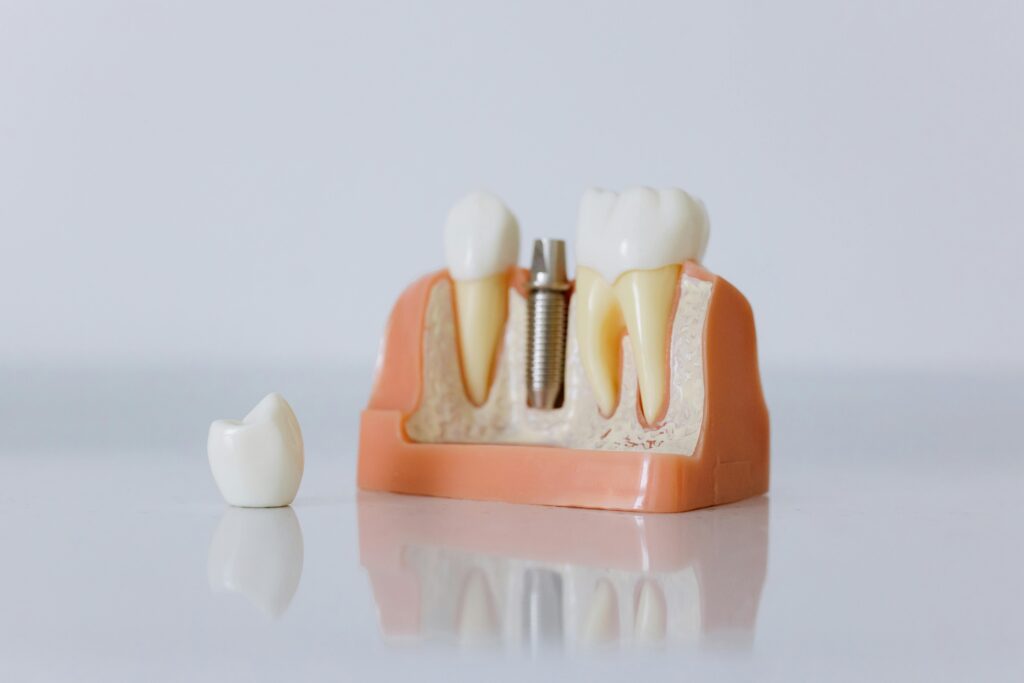
A dental implant replaces the missing tooth root with a small titanium or titanium-alloy post placed in the jawbone. After healing, that implant supports a custom crown designed to fit the space, contact neighboring teeth properly, and meet the opposing tooth in a controlled way.
That root replacement is the key difference. A bridge spans over the space, and a removable partial denture sits on top of the gums, but an implant occupies the position of the missing root within the bone. This gives it a distinct mechanical role in preserving the space.
When an implant crown is properly shaped, it acts like a placeholder with purpose. It helps maintain contact with adjacent teeth so they are less likely to drift. It restores an opposing chewing surface so the tooth on the other arch has something to meet. It also helps distribute bite forces more normally through that area.
Patients often describe the result in practical terms. Food stops packing into the space. Chewing feels more balanced. The tongue no longer keeps finding a gap. These are small daily improvements, but together they help explain why implants can be so protective over the long term.
The bone factor that people rarely think about
There is another part of the equation, and it matters just as much as shifting. After a tooth is lost, the bone that once supported the root begins to resorb, or shrink, because it is no longer being stimulated in the same way. This loss can be modest in some cases and more dramatic in others, especially during the first year.
Bone loss does not directly cause neighboring teeth to tip, but it does change the architecture of the area. The ridge can narrow and sink, making future replacement more difficult and affecting how the gums support the final restoration. This is one reason timing matters.
An implant helps transmit chewing forces to the surrounding bone, which can reduce the amount of bone loss compared with leaving the space empty. It does not stop all biological change forever, and it is not a guarantee against every kind of tissue remodeling, but it generally does far more to preserve the site than no replacement at all.
That matters in a place like Calabasas, where many patients want results that feel natural and age well. A replacement that simply fills a visible gap is not enough if the surrounding bone and gums continue to collapse. Long-term stability depends on what happens below the surface.
Why timing can make a major difference
One of the most common misunderstandings is that replacing a missing tooth can always wait without consequences. Sometimes there are sound reasons to delay, such as healing after extraction, treatment for infection, medical coordination, or financial planning. But it is worth understanding what tends to happen during that waiting Dental Implants Calabasas CA period.
In the early months after tooth loss, the body begins reshaping the site. Adjacent teeth may not move dramatically overnight, yet subtle changes can start early. The longer the space remains open, the more likely it is that some combination of tipping, overeruption, and bone loss will complicate the case.
That does not mean every patient needs immediate implant placement the same day a tooth comes out. Immediate implants can be excellent in the right setting, but not every extraction site qualifies. Factors such as infection, bone quality, gum thickness, and bite forces all influence the decision. What matters most is having a plan. Even when placement is delayed, preserving the site through grafting or temporary space management can make a huge difference.
A thoughtful dentist or specialist will look beyond the missing tooth and ask a more strategic question: what needs to happen now so this area remains restorable six months from now and five years from now?
Single-tooth implants versus other replacement options
For preventing shifting, implants have a strong advantage because they stand independently. They do not rely on adjacent teeth for support. That independence is important.
A traditional bridge can also fill a gap and may help limit some movement, but it typically requires reshaping the neighboring teeth if those teeth do not already need crowns. In the right case, a bridge is a very reasonable option. Yet it does not replace the root, and it does not preserve the bone the same way an implant can.
A removable partial denture can restore appearance and some function, but because it is taken in and out, it does not usually provide the same stability or feel. Some patients wear them inconsistently, which reduces their value in maintaining the bite relationship. They can also trap food and create sore spots if not monitored carefully.
Leaving the space alone is the option that carries the highest risk of shifting and progressive changes. It may seem economical in the short term, but many patients ultimately spend more when the untreated gap leads to added restorative or orthodontic needs.
What patients in Calabasas often ask before moving forward
People considering Dental Implants Calabasas CA providers place often ask a practical mix of questions. They want to know whether the implant will feel like a real tooth, how long treatment takes, whether bone grafting is needed, and how much maintenance is involved. Those are the right questions.
The answer is that implant treatment is highly individualized. A straightforward single implant in a healthy patient with adequate bone can be very predictable. The timeline may range from a few months to longer, depending on healing and whether extra procedures are needed. Cases involving longstanding tooth loss, bone loss, grinding, or gum disease usually need more planning.
One point worth stressing is that preventing shifting is not only about placing an implant. It is about placing it in the correct three-dimensional position and restoring it with the right contours and bite relationship. A crown that is Dental Implants Calabasas CA too narrow, too bulky, or contacts the opposing teeth improperly can create its own problems. Experience and attention to detail matter.
When the case is not straightforward
Real mouths are rarely textbook examples. A patient may be missing a tooth for ten years, have mild crowding, and grind heavily at night. Another may have excellent oral hygiene but very thin bone after trauma. Someone else may have had a failed root canal and infection around the site. These details change the treatment strategy.
In some situations, an implant alone will not fully solve the effects of shifting because the movement has already happened. A neighboring tooth may need minor orthodontic uprighting first. The opposing tooth may need reshaping or restoration if it has overerupted. There may be a need for bone grafting to rebuild lost support before the implant can be placed properly.
This is where judgment matters more than slogans. The right treatment plan is not always the fastest one. Good clinicians look for the option that protects health, function, and longevity, even if it requires phases.
A patient of mine once described it well after finishing a delayed implant case: “I thought I was replacing one tooth, but really I was rebuilding the way that whole side worked.” That is often the reality. Missing teeth rarely stay isolated problems.
Bite forces, clenching, and why design matters
Calabasas patients are not unique in this, but many adults live with a fair amount of stress-related clenching or nighttime grinding. These habits can influence both tooth movement and implant planning.
Natural teeth have a periodontal ligament that allows tiny amounts of movement and sensory feedback. Implants do not have that same ligament. They are very stable, which is an advantage for preserving space, but it also means the crown and bite need careful adjustment. If an implant crown takes too much force, especially in a patient who grinds, the restoration or surrounding components can be overloaded.
That does not make implants a poor choice. It simply means the case needs proper force management. The shape of the crown, the contacts between teeth, the material selected, and sometimes a night guard all play a role. When these factors are handled well, an implant can serve as a durable anchor that helps maintain the bite rather than destabilize it.
The role of gum health in preventing future movement
Teeth shift more easily in a mouth with ongoing gum disease or bone loss. If the surrounding teeth are already compromised, replacing a missing tooth with an implant addresses only one part of the problem.
Healthy gums and stable bone around the neighboring teeth are essential. If those teeth are inflamed, mobile, or losing support, they may continue to migrate even after the space is restored. That is why a periodontal evaluation is often part of responsible implant planning. A strong restoration placed into an unstable environment will not deliver the result patients hope for.
This is also why maintenance matters after treatment. An implant cannot decay, but the tissues around it can become inflamed if plaque control is poor. Regular cleanings, home care, and bite checks help preserve both the implant and the position of the surrounding teeth.
What the process usually looks like
For many patients, the path starts with imaging and a detailed exam. The goal is to assess the space, the quality and quantity of bone, the condition of the neighboring teeth, and the bite. Three-dimensional scans are commonly used because they show far more than a standard two-dimensional X-ray.
If the site is healthy and adequate bone is present, implant placement may be straightforward. If the tooth is being removed, the dentist may discuss immediate placement, early placement after soft tissue healing, or delayed placement after the site matures. Each option has advantages depending on the circumstances.
After placement, the implant needs time to integrate with the bone. During this phase, a temporary tooth or space maintainer may be used, especially in visible areas. Once healing is confirmed, the final crown is made to fit the bite and contacts precisely.
That precision is not cosmetic fussiness. It is part of how the implant helps prevent shifting. The neighboring teeth need proper contact so they are supported in position. The opposing tooth needs controlled contact so it does not continue drifting. Small discrepancies can have outsized effects over time.
Signs that a missing tooth is already affecting alignment
Patients often ask how they can tell whether a gap is causing movement. Sometimes the clues are subtle:
- food traps have become more frequent near the missing space
- floss snaps or frays in an area that used to feel normal
- a nearby tooth looks slightly tilted or harder to clean
- the opposite tooth seems longer or hits first when biting
- the bite feels uneven on one side
These changes do not always mean an implant is the only solution, but they do signal that the space should be evaluated sooner rather than later.
Aesthetic benefits are real, but function should lead the plan
Many people first think about implants because they want a complete smile. That is understandable, especially when the missing tooth is visible. Yet in my experience, the more lasting satisfaction usually comes from functional recovery. When the bite feels even again, chewing improves, food stops wedging in the gap, and the surrounding teeth feel stable, patients stop thinking about the area so much. It simply works.
That is the standard worth aiming for with Dental Implants Calabasas CA treatment. Not just a replacement tooth that photographs well, but one that preserves the relationships around it.
Choosing the right provider matters
Implant dentistry sits at the intersection of surgery, restorative design, bite mechanics, and tissue management. Preventing shifting teeth is not just about inserting a fixture into bone. It requires planning the final position of the crown before the implant is ever placed.
A careful provider will assess more than whether there is room for an implant. They will evaluate whether the space is still ideal, whether adjacent teeth have migrated, whether the bite is stable, and whether gum and bone conditions support a predictable result. If the case needs orthodontic correction, grafting, or specialist involvement, that should be part of the conversation from the start.
Patients should feel comfortable asking how the implant position will be planned, what happens if bone loss is present, and how the final bite will be adjusted to protect the restoration. Thoughtful answers usually reflect thoughtful care.
Why replacing one tooth can protect many others
The value of a dental implant is easy to underestimate when the missing tooth is in the back and out of sight. But the mouth works as a system. One opening in that system can alter the position and workload of several other teeth. That is why replacing a missing tooth is often less about filling a gap and more about preserving order.
A well-planned implant can help maintain spacing, reduce the risk of neighboring teeth tipping, give the opposing tooth a stable contact point, and support the bone in the area. It cannot reverse every consequence of long-term tooth loss on its own, and it is not the right solution in every case. Still, for many adults, it is the most direct and durable way to keep one missing tooth from turning into a wider alignment problem.
When patients understand that, the decision often becomes clearer. They are not simply paying for a crown on a post. They are investing in the stability of the entire bite.
Oaks Dental
5000 Parkway Calabasas, Suite 308
Calabasas, CA 91302, United States
Phone: +1 (818) 412-8349
FAQ About Dental Implants Calabasas CA
How much does a dental implant cost in California?
Costs vary with the number of teeth replaced, restoration type, imaging, and any extractions or bone grafting. Request an itemized estimate after an examination; a single advertised price may not include every treatment stage.
Can people with autoimmune disease get dental implants?
Some people may qualify, but the condition, medications, oral health, and healing risks require individual assessment. Share your medical history with your dentist, who may coordinate with your treating physician.
Can you have dental implants if you have osteopenia?
Osteopenia does not by itself establish whether implants are suitable. Your dentist must evaluate jawbone support and review bone-related medications and other risks before recommending treatment.